|
|
|
|
|
|
|
|
|
|
|
| |

Move mouse over for the CODE
|
|
|
HISTORIC HOI AN
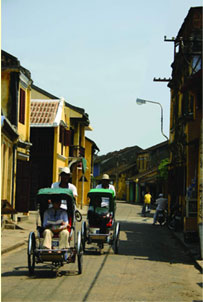
A 30-minute drive from the central city of Danang, Hoi An has earned a reputation as one of Vietnam's most picturesque towns. Declared a World Heritage Site by UNESCO, Hoi An draws visitors to its lovingly preserved mix of Vietnamese, Chinese, Japanese and French architecture - evidence of the town's fascinating past as a major trading port. From the 17th to the 19th century, Phai Pho which is Hoi An's old name riverside port was frequented by trader from as far away as Holland, China, Japan and India , who came for Vietnam's silk. porcelain, pepper, cinnamon and medicinal plants. While the trade dried up when the river filled with silt, the town distinctive architecture remains intact, having miraculously survived the wars of the 20th century.
Hoi An's quarter features traditional shop - houses, the facades of which are made from carved ironwood. |
|
|
The front rooms of these houses served as shops, while the families lived on the second floors. Central and back courtyards allowed both sunlight and fresh air to penetrate. To this day, many houses have a pair of carved wooden yin yang symbols are thought to protect the house's inhabitants from ghosts and bad luck.
Go back |
| |
|
| |
THE JAPANESE COVERED BRIDGE
 |
|
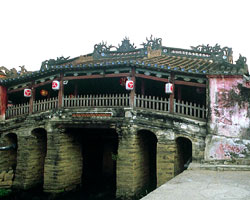
Japanese trader built the Japanese covered bridge, or Lai Vien Kieu (bridge for passengers-by from far away), in 1593 to connect the town's Japanese and Chinese districts. On one side, a pair of stone dogs guards the bridge's entrance; the pair of stone monkeys protects the opposite end. One story claims that construction of the bridge began in the year of the Dog and finished in the year of the monkey, while another tale holds that the statues were erected in honor of Japanese emperors born under those animal's signs. The northern side of the bridge contains the small temple, Chua Cau (Bridge Temple).
|
Go back |
| |
|
| |
THE MY SON HOLY LAND
The My Son holy land is considered the biggest and most symbolic temple complex of the Champa Kingdom running the length of the southern central coastal area. The complex is comparable to order great structures, which bear the hallmarks of Indian civilization in the Southeast Asian region like Angkor of Cambodia, bagman of Myanmar, Ayuthaya of Thailand and Borodudur of Indonesia.
Located in Quang Nam province, 68 km Southwest of Hoi An, My Son lies in a luxuriant valley about 2 kilometers in diameter, surrounded by hills and mountains. As recorded in the oldest existing stele, in the late 4th century, King Bhadravarman had a temple built in the area and dedicated to Shiva, Champa's protector god. From then until the 13th century, new temple and towers were built by successive Cham monarchs. These temples and towers, which served as sanctuaries and shrines respectively, were all dedicated to Shiva and at the same time King Bhadravarman and his successors. By the 15th century, the Cham people migrated to the south, leaving MySon in ruins and in total oblivion in the tropical rain forests. The complex was not discovered until 1898. |
|
|
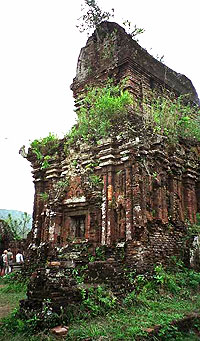
According to 1902 statistic, My Son boasted 71 brick and stone structures. Unfortunately, the complex has been heavily damaged by continuous warfare and as a result, there remain only 32 ancient towers, of which only 20 have their original figures kept relatively intact.
The quadrilateral towers are constructed of red bricks, and their tiered roofs taper off towards the top. All the four sides of every tower have relief carvings depicting deities, human beings or animal creatures on baked brick in an airy style. It is interesting to note that researchers are still unable to find our how Cham craftsmen have put all the bricks together without using any mortar. Inside each main tower, a symbol of Linga or an icon of Shiva is placed for worship together with Bhadravarman. In addition, there are also ingenious relieves carved on brick and stone statues in the decorative style of the Cham people of thousands of years ago.
Some of the relics from the MySon ruins have been reserved and are on display in Cham Museum in Da Nang, contributing to its reputation as the finest collection of Cham sculptures in the world.
Go back |
| |
|